
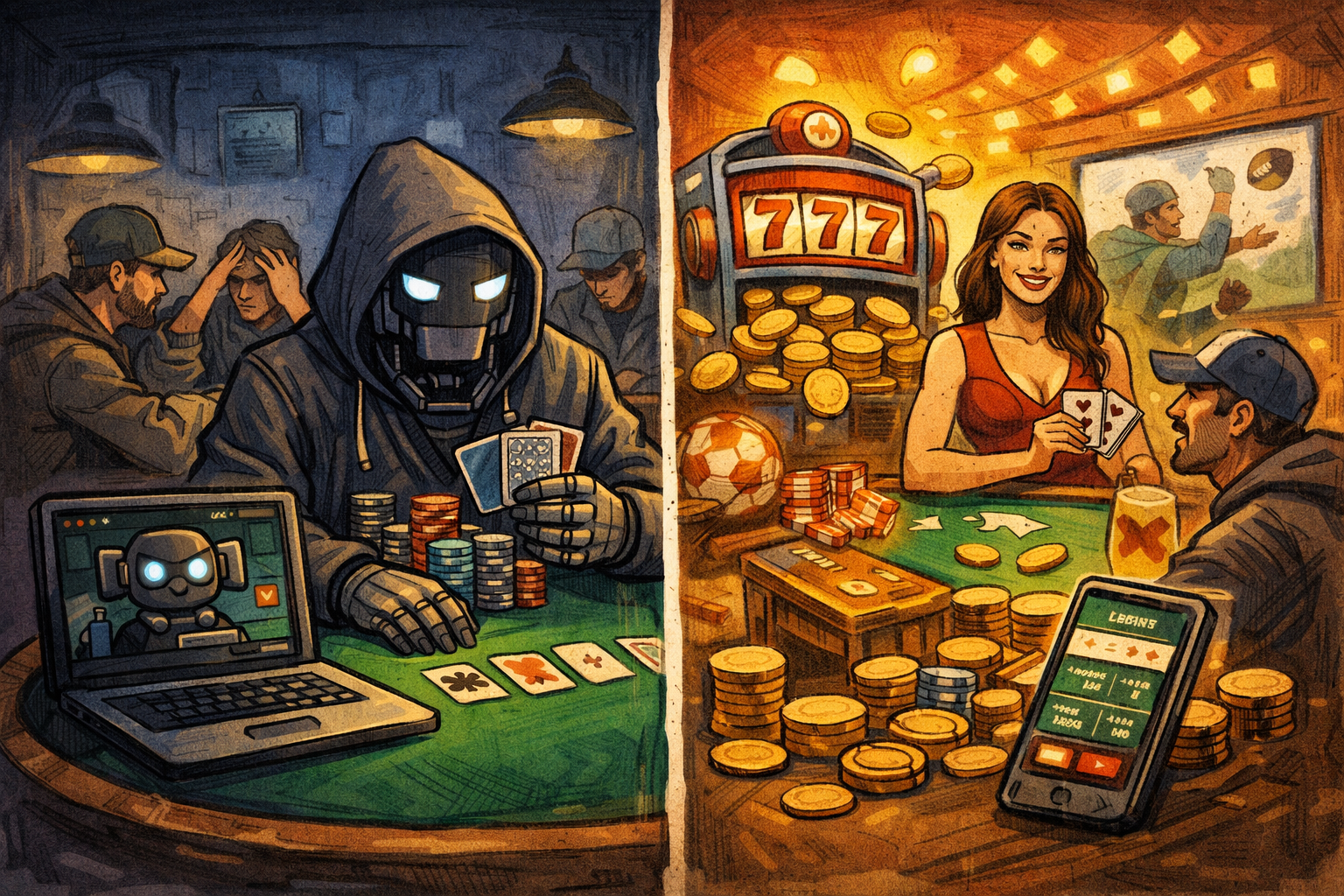
There is a quiet crisis unfolding at the online poker tables, and most players have already felt it without being able to name it. The games are tighter. The edges are thinner. The recreational players who once made the ecosystem profitable have largely vanished, replaced by a field of opponents who play with an eerie, algorithmic precision. Meanwhile, online slots are posting record revenues, live dealer games are expanding into new markets, and sports betting is enjoying explosive growth across the United States.
The divergence is not coincidental. Artificial intelligence has fundamentally disrupted poker in ways that other forms of online gambling are structurally immune to — and understanding why requires looking at what makes poker different from everything else in the iGaming landscape.
The Core Vulnerability: Poker Is a Solved Problem
Poker’s defining feature has always been that you play against other humans, not the house. This is what made it intellectually compelling, culturally romantic, and — for a generation of online grinders — financially viable. It is also precisely what made it vulnerable to AI in a way that slots, blackjack, and roulette never will be.
In 2017, Carnegie Mellon University’s Libratus system defeated top professional players in heads-up no-limit hold’em. Two years later, its successor Pluribus solved six-player tables. These were not incremental improvements. They represented a categorical shift: machines had crossed the threshold from “useful training tool” to “unbeatable opponent,” and the implications cascaded through the online poker economy with remarkable speed.
The problem is not that players are literally running Pluribus at the tables, though some certainly attempt to use derivative solver tools in real time. The deeper issue is that AI research produced a publicly available blueprint for near-optimal play. Game Theory Optimal strategies, once the domain of elite professionals who spent years developing intuition for balanced ranges and mixed frequencies, are now accessible to anyone willing to spend a few hundred dollars on solver software and a few months studying its output.
The result is a compression of skill gaps that has made the games dramatically less profitable for everyone except the platforms themselves. When the majority of a player pool is executing strategies derived from the same computational framework, the edge between a competent regular and a strong professional shrinks to a margin that rake — the house’s cut of each pot — frequently exceeds. The ecosystem becomes extractive rather than competitive.
Why Recreational Players Left
The downstream effects on player demographics have been devastating. Poker has always depended on a healthy influx of recreational players — people who play for entertainment, who make predictable strategic errors, and whose losses subsidize the winnings of more skilled participants. This is not cynical; it is simply the economic structure of any skill-based competitive activity, from poker to fantasy sports to competitive chess.
AI-derived strategies accelerated the departure of these players in two ways. First, the games became less fun. Recreational players do not enjoy sitting at tables where every opponent plays a tight, aggressive, solver-approved style. The creative bluffs, wild calls, and unpredictable action that made poker exciting gave way to a grinding uniformity that feels more like facing a spreadsheet than playing a game. Second, the learning curve steepened beyond what most casual players are willing to climb. When the baseline competence of the average opponent rises sharply, the experience for a newcomer shifts from “challenging but learnable” to “punishing and opaque.”
Operators have tried to address this through anonymous tables, shorter formats, recreational player protection algorithms, and various structural innovations. Some of these measures have slowed the decline, but none have reversed it. The fundamental dynamic — that AI has made the skill floor too high for casual participation to be enjoyable — persists regardless of the format.
The Structural Immunity of Other iGaming Verticals
Compare poker’s trajectory to the segments of online gambling that are thriving, and the contrast becomes immediately clear.
Slots, which generate the majority of revenue for the best online casinos usa, are entirely unaffected by AI advancement. Each spin is determined by a random number generator. There is no opponent to outplay, no strategy to optimize beyond bankroll management, and no skill gap to exploit. AI cannot gain an edge because there is no edge to gain. The experience is purely entertainment-driven, which makes it resistant to the kind of competitive erosion that hollowed out poker.
Live dealer games occupy a similar position. While they add a social dimension through real-time video interaction with human dealers, the underlying game mechanics remain house-banked and probability-driven. A player at a live blackjack table is not competing against the other seated players. AI might theoretically assist with card counting in a simulated environment, but the continuous shuffling machines and eight-deck shoes used by reputable live dealer providers render this irrelevant in practice.
Sports betting presents a more nuanced case. AI and machine learning are extensively used by sharp bettors and syndicates to identify market inefficiencies, and this has certainly squeezed the margins available to casual handicappers. However, the structure of sports betting insulates it from poker’s fate in a crucial way: the bettor’s opponent is the sportsbook, not other bettors. Sportsbooks respond to sharp action by adjusting lines, which actually improves market efficiency for everyone. The recreational bettor placing a parlay on their favorite team is not directly harmed by the existence of AI-powered models elsewhere in the market. Their experience — and their entertainment value — remains intact.
The Bot Problem Compounds Everything
Beyond the diffusion of solver strategies among human players, poker faces a second AI-driven threat that other verticals largely avoid: automated play. Poker bots — software programs that play autonomously using AI-derived strategies — have become increasingly sophisticated and increasingly difficult to detect.
The economic incentive is straightforward. A bot running a near-GTO strategy can profitably grind low and mid-stakes games around the clock without fatigue, tilt, or the need for breaks. Even a modest edge, compounded across tens of thousands of hands per day, generates meaningful revenue. For the humans sitting at these tables, the effect is indistinguishable from facing an unusually disciplined, tireless opponent who never makes emotional mistakes.
Operators invest significant resources in bot detection, employing behavioral analysis, timing pattern recognition, and machine learning classifiers trained on known bot signatures. But the arms race is inherently asymmetric. Each generation of detection technology is met by more sophisticated evasion techniques, and the fundamental challenge — distinguishing between a human who plays like a solver and a bot that plays like a solver — grows harder as human strategy itself becomes more computationally informed.
Slots, live dealer games, and sports betting face no equivalent problem. There is no strategic advantage to automating a slot session, and sports betting markets are structured such that automated sharp action simply moves lines rather than degrading the experience for other participants.
What the Data Shows
The numbers reflect this divergence clearly. According to reporting from the American Gaming Association, commercial gaming revenue in the United States reached record levels in recent years, driven overwhelmingly by sports betting expansion and continued strength in slot and table game segments. Online poker, by contrast, has plateaued or declined in most markets where it is offered, despite the broader growth of digital gambling.
Player pool liquidity — the number of concurrent active players, which serves as the most reliable health metric for online poker — has trended downward across major platforms over the past several years. Average stakes have compressed, and the proportion of multi-tabling regulars relative to recreational players has shifted decisively toward the former. These are the structural markers of an ecosystem under pressure, and they correlate directly with the proliferation of AI-derived tools and strategies.
Can Poker Adapt?
The question facing poker operators and the broader community is whether the game can evolve to survive in a post-AI environment. Several approaches are being explored, each with meaningful trade-offs.
Format innovation is the most promising avenue. Short-deck hold’em, which plays with a stripped 36-card deck, creates more action-heavy dynamics that resist solver optimization more effectively than traditional formats. Bounty tournaments and lottery-style sit-and-go formats shift the variance structure in ways that keep recreational players engaged despite the rising skill floor. These formats do not eliminate AI’s influence, but they change the game’s texture enough to sustain entertainment value.
Real-time assistance detection is another frontier. Some platforms are exploring client-side monitoring that can identify whether a player is running solver software during a session. The privacy implications are significant, and the technical reliability remains questionable, but the direction reflects the severity of the threat.
Perhaps the most pragmatic response is the one already underway: poker is becoming a smaller component of diversified iGaming platforms rather than a standalone product. Operators that once built their brands around poker now treat it as one vertical among many, cross-selling players into slots, live casino, and sports betting where the business model is more resilient. For these operators, poker serves primarily as an acquisition channel — a prestige product that attracts a certain demographic — rather than a profit center in its own right.
The Broader Lesson
Poker’s AI-driven decline is not a story about technology destroying an industry. It is a story about a specific competitive structure — human-versus-human, skill-based, information-asymmetric — encountering a technology that neutralizes the very dynamics that made it compelling. The game still exists, professionals still profit, and millions still play. But the golden era of online poker, when a talented amateur could learn the game and build a bankroll against a soft player pool, is over. AI did not merely raise the bar; it fundamentally altered what the bar measures.
The rest of the iGaming industry watches this cautionary tale with a mixture of sympathy and relief. Their products were built on randomness, entertainment, and house edges — foundations that AI cannot erode. As long as people want to spin a slot, place a parlay, or sit across from a live dealer, those segments will continue to grow on their own terms, untroubled by the algorithmic revolution that reshaped poker beyond recognition.
The lesson extends beyond gambling. Any competitive ecosystem where the skill gap between participants is the primary source of economic value is vulnerable to the same dynamic. When AI compresses that gap, the incentive structure collapses. Poker was simply the first to learn this the hard way.